
By Aga Cummins
The elements of sound therapy are always present at both antenatal and regular yoga classes hosted by me. You may encounter them at the beginning and towards the end of each session.
Modern science focuses more and more on the negative impact of stress on the quality of our lives. Experienced every day, unattended stress impacts both our mental and physical health. The area of sound therapy is relatively new and uncharted territory in Western research. However the trials conducted recently have led scientists to the same conclusions: sound therapy reduces the levels of daily stress in humans.
When we are awake the regular frequency of our brain waves is Beta. Sound therapy tools help us to reach deeper brain waves: Alpha and Theta. Those frequencies bringing meditative states, deep relaxation, feelings of infinite calm, inner brightness and enhance our intuition. Sound is a type of energetic medicine that created holistic space that may heal stress, anxiety, depression and prolonged pain. Other benefits are positive impact on the sense of wellbeing, creativity, imagination, improved self awareness and self confidence. Ancient instruments, such s Tibetan singing bowls, when used create vibrating sounds harmonized with the frequency of seed sounds such as ‘AUM’ and ‘OM’. Those and human brain waves are synchrised, they both have the same frequency. Henceforth the positive impact on our parasympathetic nervous system. This promotes the ‘rest and digest’ state as opposed to ‘fight and flight’ mode disturbing healing processes and increasing mental health deficiencies. Harmonious vibrations enhance relaxation, slow down our breathing, heart best and enable the feelings of wellbeing.
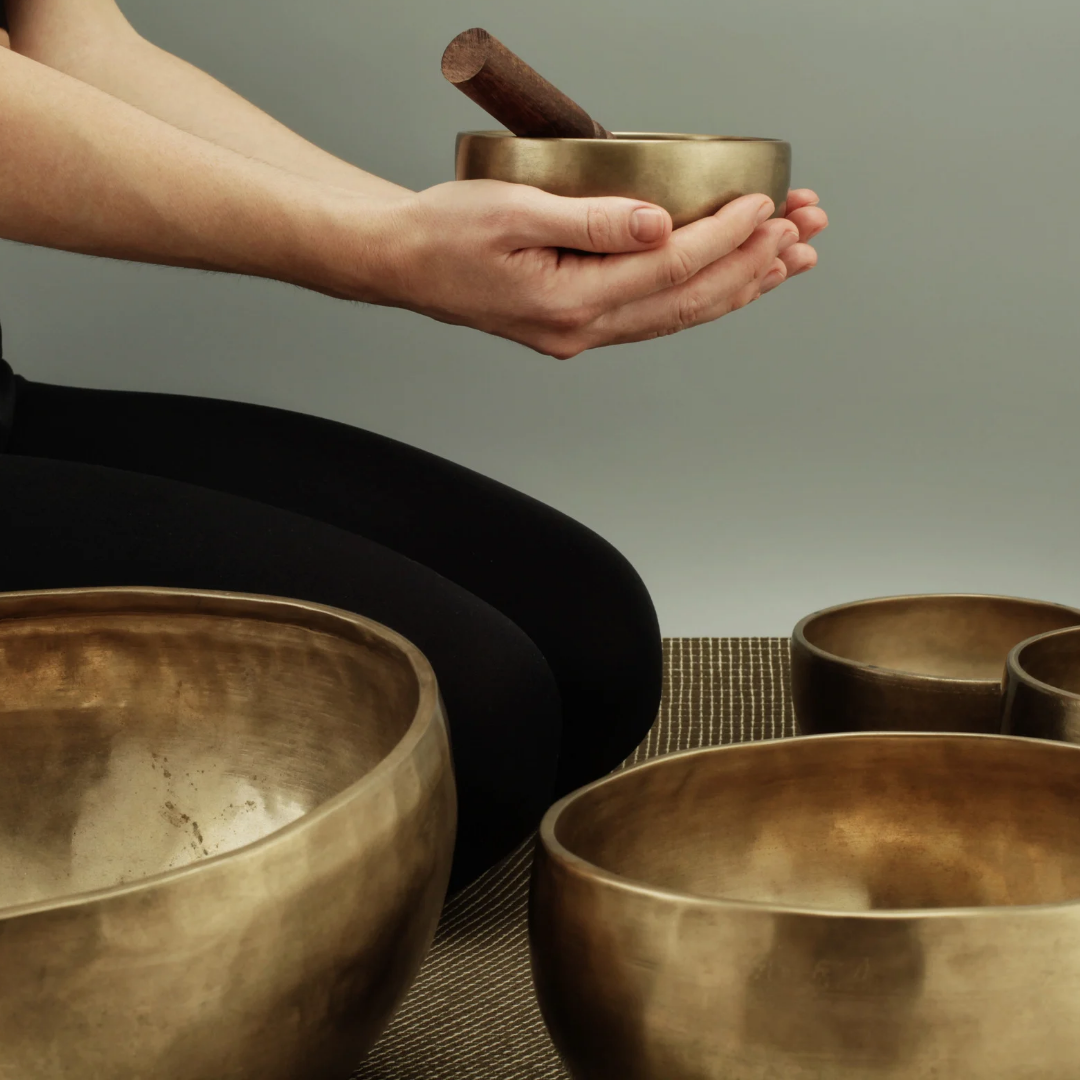
One of the most effective instruments were Tibetan singing bowls.
Singing bowls belong to a group of acoustic instruments – idiophones. Their characteristic feature is that they generate non-harmonic multi-tones. Therefore, they are instruments which are manufactured using traditional technologies while maintaining repeatability of alloy and valuable acoustic parameters. Depending on the bowl types and sizes, they contain from 5 to 12 bronze components and other metals. Some are handmade and it takes over 72 hours of hard labour to have one ready.
Depending on the source they are reported to be known by humans for the last 5000 to 8000 years. The sound of singing bowls has been known since ancient times. One of the first descriptions of them can be found in the work “ 10th Book of Architecture” which describes the usage of resonant dishes for medical and acoustic purposes. They were crucial at shamanic rituals of bon religion as well as by Buddhist monks for meditation and healing practices. The legend has it they came to Tibet all the way from India with Buddhism around 2000 years ago.
Tibetan refugees fleeing their country in 1959 due to Chinese invasion brought Tibetan bowls with them. Hence even right now they are mostly made outside of Tibet.
Westerners rediscovered them at the end of the 60is of the XX century. They drew the attention of musicians visiting Nepal and India’. Sound therapy with Tibetan singing bowls was introduced to Western Europe in the 80ies of the XX century by Peter Hess, a German engineering graduate (FH) in Physical Technology who has extensively researched the effects of sound on people.
Benefits of the sound of Tibetan singing bowls:
- Removal of toxins from the body from extracellular spaces
- Tensions elimination
- Facilitating the rehabilitation process in the area of joints, especially the spine and wound healing
- Stimulating effects on all meridians and individual body organs
- Improvement of metabolic processes and intracellular respiration
- Stress reduction
- Life motivation increase
- Discovering new passions for life, which has an invaluable impact on efficiency in everyday life and professional work
- Eliminating problems with concentration, breath, backache, neckache, headache and insomnia; overcoming struggle with constant fatigue, fear of making decisions, so-called “occupational burnout”.
Are there any contradictions?
Yes. Some of them are:
- A pacemaker (cardioverter). It has a built-in battery and a device is implanted under the skin near a heart together with electrodes which read morphology. When the bowls are hit, occur vibrations which may cause disruptions of the device’s work.
- Electrophysiology procedure (ablation).
- Buerger’s disease
- Raynaud’s disease
- First trimester of pregnancy (0 to 12 weeks)
The human health effects of singing bowls: A systematic review Jessica Stanhope et al. Complement Ther Med. 2020 Jun.
Effects of Singing Bowl Sound Meditation on Mood, Tension, and Well-being: An Observational Study
Tamara L Goldsby et al. J Evid Based Complementary Altern Med. 2017 Jul.